9 hotspots you must see in Bordeaux
Bordeaux is the city that comes to mind when you think of wine! The city center is filled with historical sites and architecture, and in recognition of its beauty, the entire old town of Bordeaux was declared a UNESCO World Heritage Site in 2007.
My first impression of the city was more aristocratic and elegant than I expected. Thanks to its location at the confluence of the Garonne River and the sea, Bordeaux has excellent seafood and has been a center of trade and transportation since the Middle Ages. It grew to rival Paris as a port for the export of wines from the south of France to the rest of the world.The vestiges of its ‘well-to-do’ past are evident in the endless rows of ornate architecture along the river. State-of-the-art trams whiz by along the streets, both large and small, and you’ll find yourself snapping photo after photo of this unique blend of old and new.
Saint-André Cathedral
Bordeaux City – Private Guided Walking Tour with Local Sophia
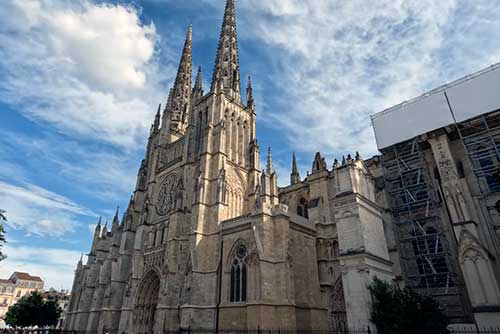
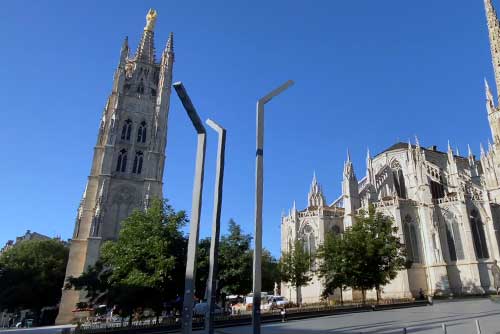
Another standout in the old town is Saint-André Cathedral. It’s considered the most beautiful religious building in Bordeaux, with its 81-meter-high spire pointing sharply toward the sky. The cathedral is so steeped in Bordeaux’s history that it’s often referred to as the “church of the royals” because the royal wedding ceremony was held here. Construction began in 1096 and took five centuries to complete. It is unique in that it is a mix of architectural styles from different periods, including French Gothic and Romanesque. St. André’s Cathedral was listed as a UNESCO World Heritage Site in 1998, and the entire city of Bordeaux is a World Heritage Site. Considered the most beautiful religious building in Bordeaux, it was built over five centuries and is a mix of styles. The central hall, built in 1096, is Romanesque, while the King’s Gate (La Porte Royale), on the north wall of the nave, is 13th-century French Gothic.
The center of Bordeaux,
the Grand Théâtre
Bordeaux City – Private Guided Walking Tour with Local Sophia
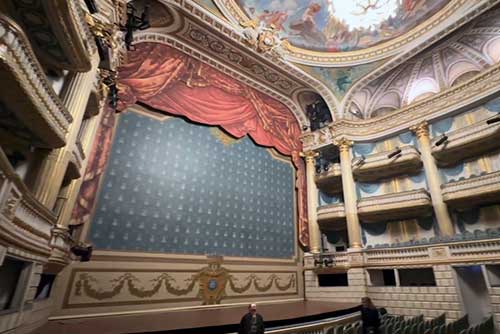
Bordeaux’s Grand Théâtre, with its 12 Corinthian columns exuding an aura of power, is always bustling with people. The historic theater, which opened in 1780, still hosts performances such as opera and ballet. Inside the theater is a circular cupola painted by Jean-Baptiste Robin in the 18th century. The blue, gold, and white colors symbolize the French royal family and are reminiscent of the Palace of Versailles. Cafes and restaurants line the area overlooking the Grand Theater. It’s easy to grab a seat and watch the people and trams come and go.
Place de la Bourse
Bordeaux City Sights Walking Tour
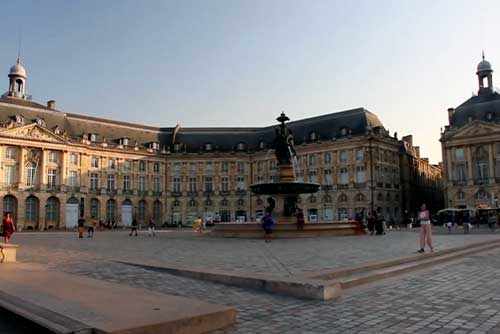
The creation of Place de la Bourse in the 18th century finally freed the medieval city of Bordeaux.During the Middle Ages, Bordeaux was surrounded by a circle of ramparts. With the creation of Place de la Bourse in the 18th century, the walls disappeared and the square opened up to the Garonne River with open arms. Designed by Jacques Gabriel, Louis XV’s chief architect, and his father, it is one of the most iconic places in Bordeaux. In the center of the wide square is the Trois Grâce fountain, with the figures of Gratier, Aglaia, and Euphrosyne from Greek and Roman mythology. Perfectly symmetrical 18th-century architecture, like the Decalcomanie, surrounds the square. It is currently used as a customs office on the left and a stock exchange on the right. There is a café on the ground floor of the pavilion in front of the square, where you can relax with a coffee.
The Mirror of Water,
Le miroir d’eau
Bordeaux City Sights Walking Tour
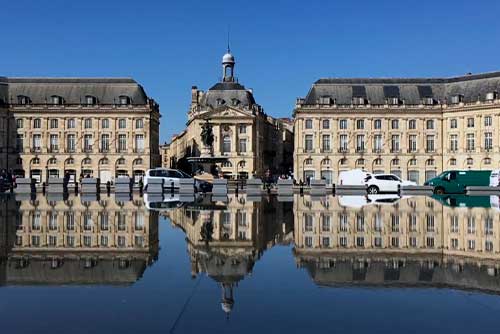
Opposite Place de la Bourse, this beautiful water mirror is a must-see and #1 Instagrammable spot for travelers to Bordeaux. It’s said to be the largest water mirror in the world, with water 2 centimeters deep pooling on top of granite tiles. Buildings, people, and cars are reflected in the water, creating a spectacular sight. But it’s not just standing water. It cycles through a three-minute water charge, 15 minutes of mirror effect, five minutes of draining, and three minutes of fog. The streams of water from the 900 jets are a mystery in themselves. During the day, it shines like tinfoil in the sunlight, and at night, the buildings surrounding Place de la Bourse are lit up one by one. The lights twinkle on the empty pools of water, and the classicist buildings seem to float on the water. It has a different charm than during the day.
Europe’s largest public square,
Esplanade des Quinconces
Bordeaux Walking Tour – Private
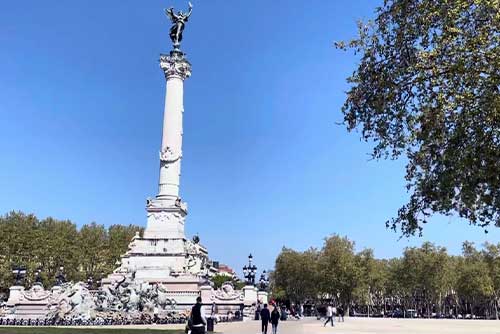
“Quinconces” is French for five-pointed dice. The name comes from the shape of the square. With a total area of 120,000 square kilometers, it’s one of the largest in Europe. More than half of the square is a green area surrounded by trees, and the fresh air will make you happy. On the west side of the square, the 40-meter-high Gironde monument stands tall. It was built to honor the members of the Gironde party who were victims of the Reign of Terror during the French Revolution. At the top, the Statue of Liberty holds a broken chain symbolizing freedom in one hand and a palm branch symbolizing victory in the other. It is flanked by two bronze fountains, each with a figure representing unity, charity, abundance, strength, and the republic.
Jardin Public
Bordeaux Walking Tour – Private
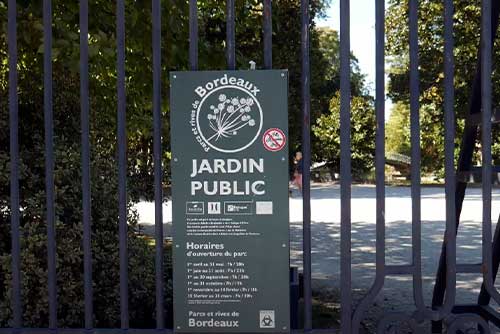
The lush greenery and colorful flowers are sure to cheer you up. Created in 1746, the Jardin Public is an English-style garden built by Napoleon III and has remained unchanged since then. It’s not uncommon to see walkers and joggers in the park, which covers 10 hectares. On one side of the garden is the Natural History Museum and a small botanical garden with a wide variety of plants. At the oldest puppet theater in France, founded in 1853, you can watch puppet shows by the Guérin family, who have been performing for over 150 years.
La Tour Pey ,
Berland for a panoramic view of Bordeaux
Bordeaux Walking Tour – Private
The bell tower right next to St. André Cathedral. Built in the 12th century, the bell tower was built separately because the cathedral tower could not support the weight of the bells. The gilded statue of Mary at the top immediately draws the eye. In 1617, a storm damaged part of the tower, and in 1853, a huge 11-ton bell was added. To protect the building, the number of visitors is limited to 19 at a time, so go early in the morning to avoid lines. The crown jewel of the tower is the observation deck at the top. After walking up the 233 steps, you’ll be rewarded with a beautiful view of the city. The sweaty climb will soon be forgotten. You can see the city of Bordeaux in all directions, including the Saint-Domingue Cathedral.
Cité du Vin
Private Bordeaux Walking Tour with La Cite du Vin and a Canelé
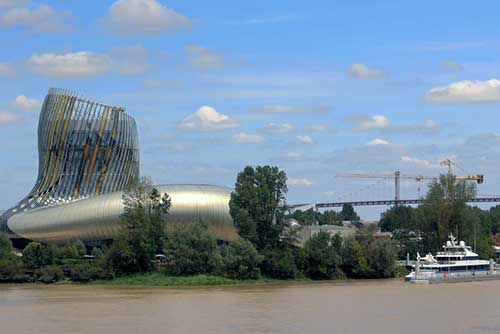
Bordeaux is a wine city, and you have to experience it. If you have enough time, you can visit one or two of the wineries scattered around the outskirts of the city, but it’s a bit much for a day trip. That’s where Bordeaux comes in with its Cite du Vin, a wine museum.
It’s the only one of Bordeaux’s main attractions that’s outside the old town, so you’ll have to take a tram up the river for five stops. The museum’s exterior is distinctive. The design was inspired by the swirling motion of a wine glass when you twirl it.
Inside, you’ll find a vast collection of information about famous wineries and grape varieties from around the world, as well as bottle designs and labels. A glass of wine is included with the museum ticket, so you can get recommendations for your favorite wines. Grab your glass and head up to the 8th floor observation deck. As you sip your wine while gazing out over the puffy clouds, the lazy river, and the city of Bordeaux, you’ll realize that you’re in for a real treat.
Saint emilion
Saint Emilion Day Trip with Sightseeing Tour & Wine Tastings from Bordeaux
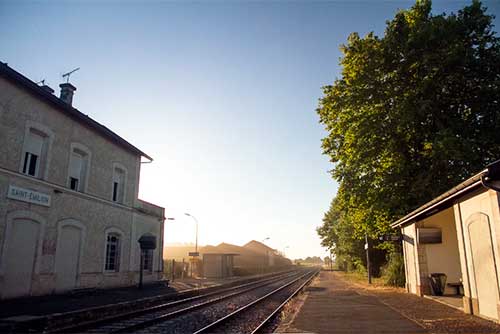
Saint-Emilion is the best of both worlds: a medieval village tour and a winery tour. Recognized enough to be designated a World Heritage Site in 1999, it was the site of the 8th-century monk Émilion’s hermitage, which later became a village. Today, the region is known for producing Grand Cru Classe-rated wines. Most of the village can be explored in an hour or two. The surrounding vineyards are endless and the scenery is stunning. Walking up the cobblestone streets and looking down on the town from the bell tower square (Place du Clocher) will make you feel like you’re back in medieval times. Take a stroll around the historic village, including the Eglise Monolith, the bell tower, and the cloisters.
Visit the wineries around town for tastings and to get a better deal on quality wines. Famous wineries include Chateau Ozon, Chateau Cheval Blanc, and many more, where you can enjoy a quick tasting and then purchase. Saint-Emilion is also famous for its wine festival. They take place on the third Sunday of June and September, with the latter celebrating the blooming of the grape blossoms and the former the harvest. If you visit during these times, you’ll get to experience the festive atmosphere.